
Posted: January 24, 2026 | Industry News
A rare stand of old-growth forest, with trees approaching 400 years of age, has been identified on a newly protected 1,513-acre mountain tract acquired by the Foothills Conservancy of North Carolina. The discovery was made during a biological survey of land surrounding Mike Mountain, now being added to the conservancy’s Pinnacle Mountains Preserve in Rutherford County.
Researchers identified five distinct pockets of old-growth forest, some spanning as much as 75 acres. The dominant oak and hickory trees in these areas predate the American Revolution—and in some cases may date back to the early 1600s. In a region where most forests have been logged at least once, the find is exceptionally rare.
According to Kevin Caldwell, a conservation biologist with Mountains-to-Sea Ecological, the trees likely survived widespread logging due to the area’s steep, rugged terrain. Some trees tower nearly 140 feet, while others are twisted, stunted, or bent from thin soils, rock outcrops, and limited sunlight—features that may have made them less attractive to early loggers.
“The majority of these canopy trees are easily 250 to mid-300 years old, and some are probably pushing 400,” Caldwell said. “This is a forest that has never experienced timber extraction. All the biomass is intact. It’s been shaped only by natural disturbances like fire, wind, and ice.”
Caldwell, who has surveyed forests for more than 25 years, described the site as awe-inspiring—not just for the living giants, but also for standing dead trees and fallen logs that now support new life. Old-growth forests are not defined solely by tall trees, he noted; they also include slow-growing understory plants and shrubs that may be hundreds, or even thousands, of years old.
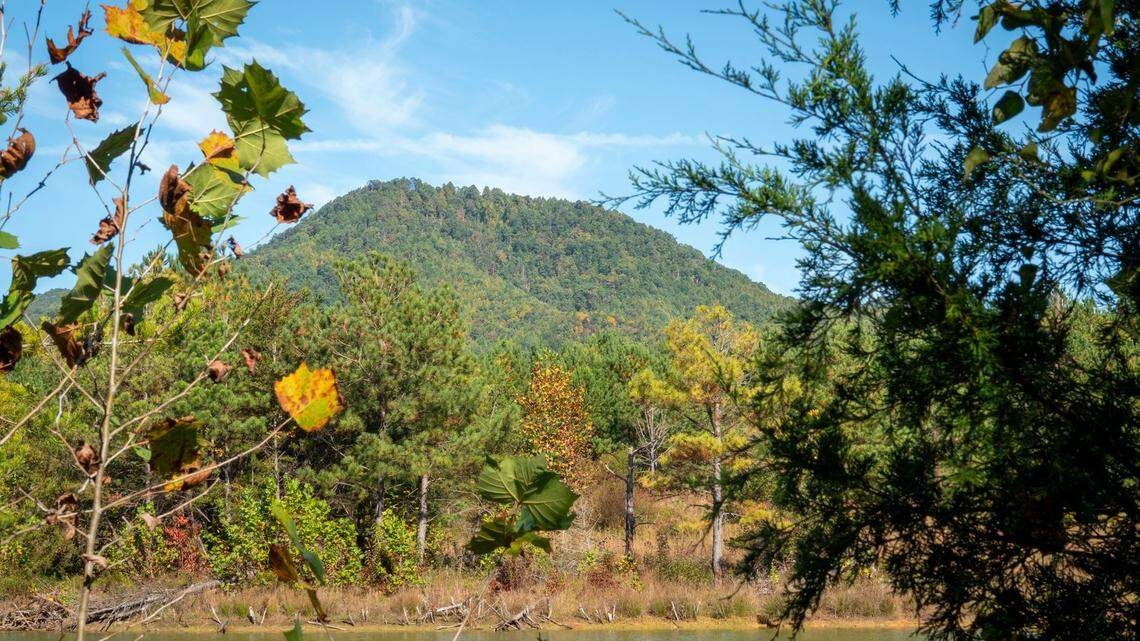
Tree ages were estimated using a combination of bark characteristics, height, and trunk circumference. While remnants of an old road were found near one forest pocket, there are currently no public trails leading directly to these areas.
The newly protected tract—known as Pinnacle Mountains South—was purchased from conservationist Tim Sweeney at an undisclosed price. With this acquisition, the Pinnacle Mountains Preserve now totals 4,150 acres and borders a 62,500-acre network of state and federal conservation lands. Together, these properties form a growing conservation corridor linking the South Mountains to the Blue Ridge Mountains.
At the core of the property is the Mike Mountain–Pinnacle Mountain Natural Area, designated “Exceptional” by the North Carolina Natural Heritage Program. The site supports 17 rare species and natural communities, making it one of the most biologically significant areas in the region.
Looking ahead, Foothills Conservancy plans to collaborate with local and state partners to develop future public access, including a trail connection to the Wilderness Gateway State Trail—a planned 170-plus-mile trail system that will expand recreational access across nearby conservation lands.
For now, the ancient forest remains quietly protected—an uncommon, living reminder of what much of the Southern Appalachian landscape once looked like, and what careful conservation can still preserve.